

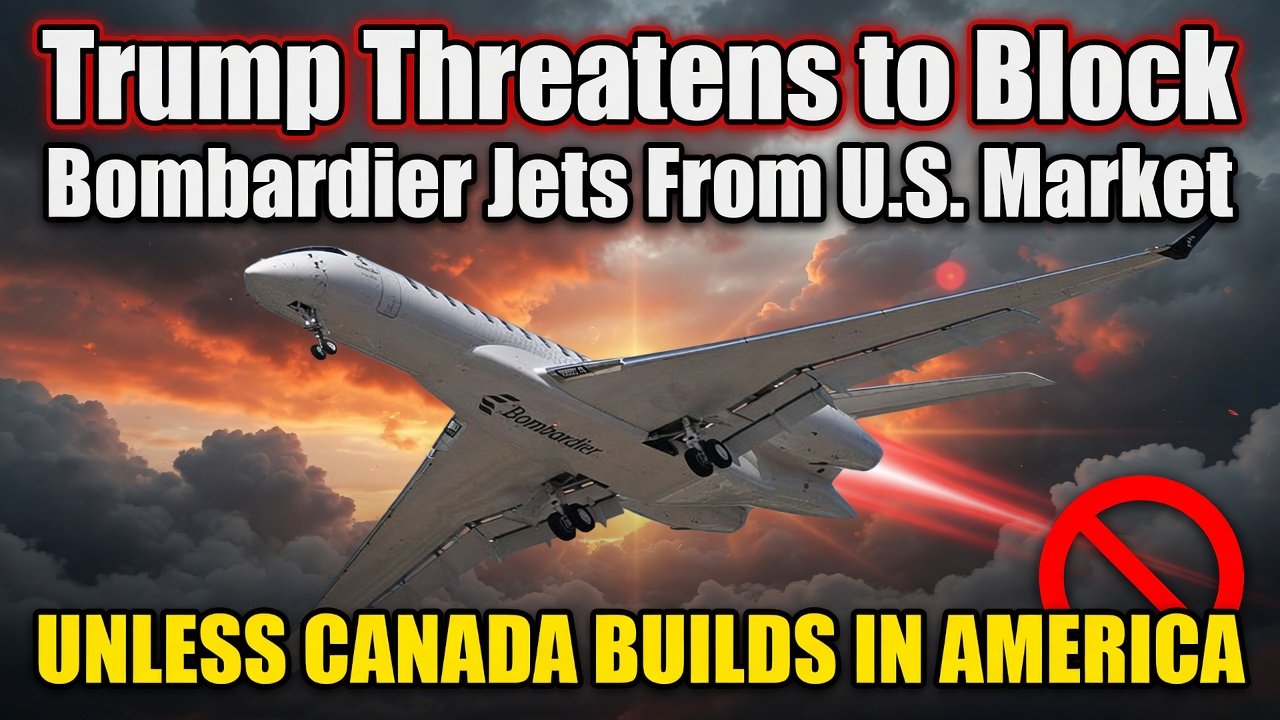
Trump Threatens to Block Bombardier Jets From U.S. Market Unless Canada Builds in America
Trump Bombardier Jets dispute has added a fresh layer to escalating trade tensions between the United States and Canada. U.S. President Donald Trump has threatened to prevent Canadian aircraft manufacturer Bombardier from selling its jets in the United States unless the company begins manufacturing aircraft on American soil.
Trump made the comments on September 7, arguing that Bombardier benefits significantly from the U.S. market while Canada has adopted policies that he considers unfair to American companies.
The threat comes as Washington and Ottawa remain engaged in a broader trade dispute involving tariffs, market access and disagreements over the treatment of companies operating across both countries.
Trump Demands Bombardier Manufacture in the U.S.
Trump said Bombardier should no longer be permitted to sell its aircraft in the United States unless it starts manufacturing them inside the country.
He accused the Canadian company of benefiting from American buyers and infrastructure while claiming that Canadian policies disadvantage U.S. businesses.
The latest statement represents another attempt by the Trump administration to use access to the large U.S. market as leverage to encourage foreign manufacturers to increase production within the United States.
However, it remains unclear exactly how such a restriction would be implemented.
Bombardier Has a Significant U.S. Presence
Despite being headquartered in Canada, Bombardier already has a substantial footprint in the United States.
The company employs thousands of Americans across multiple facilities and works with a large network of U.S. suppliers.
Bombardier also operates facilities connected with aircraft services and maintenance in the United States.
This makes the dispute more complicated than a simple Canada-versus-America manufacturing conflict.
A restriction on Bombardier aircraft could potentially affect American businesses, aircraft operators, suppliers and workers alongside the Canadian company.
Why Bombardier Is Important to the U.S. Aviation Market
Bombardier is one of the world’s major manufacturers of business jets and has a significant customer base in the United States.
Large numbers of Bombardier aircraft already operate in the American market. The company’s aircraft are used by private operators, corporations and aviation companies.
A sudden restriction could therefore create uncertainty for aircraft buyers and operators that depend on Bombardier products and services.
The company’s extensive American supply-chain and service presence could also make a potential restriction more complicated to implement.
Trump Revives Earlier Bombardier Dispute
The latest threat is not the first time Trump has targeted Bombardier.
Earlier in 2026, Trump threatened measures against Bombardier aircraft and proposed tariffs on aircraft manufactured in Canada.
That earlier dispute was connected to Canada’s certification of aircraft manufactured by Gulfstream, a U.S. rival of Bombardier.
The threatened measures were ultimately not implemented, but the disagreement continued to influence relations between the two countries.
Gulfstream Certification Dispute Returns to the Spotlight
Trump has accused Canada of unfairly restricting American aerospace companies, particularly Gulfstream.
Canadian officials have disputed the suggestion that the certification process was politically motivated, maintaining that aircraft certification is based on regulatory and safety requirements.
The disagreement over Gulfstream has become an important part of the background to the latest Bombardier dispute.
Trump’s latest comments therefore revive an aerospace disagreement that has already contributed to tensions between Washington and Ottawa.
Canada Imposes Retaliatory Tariffs
The Bombardier dispute comes as Canada and the United States remain involved in a wider tariff confrontation.
Canada has introduced retaliatory measures against various U.S. products in response to American tariffs on Canadian goods.
The expanding trade dispute has affected several industries and increased uncertainty for companies operating across the two countries.
The aerospace industry could become another major area of disagreement if the Bombardier threat develops into formal policy.
Could the Threat Affect U.S. Aircraft Operators?
A potential restriction on Bombardier aircraft could have consequences for U.S. operators that already use the company’s planes.
Aircraft purchases involve long-term maintenance, spare parts, service agreements and financing arrangements. Any uncertainty around market access could affect companies considering Bombardier aircraft.
The impact could extend beyond new aircraft sales if regulatory or certification measures were introduced against existing aircraft.
However, no broad grounding of Bombardier aircraft in the United States has been announced.
Analysts Question How a Ban Would Work
One of the biggest uncertainties surrounding Trump’s threat is the legal and regulatory mechanism that would be used.
Aircraft certification is normally governed by aviation safety regulators rather than being determined solely by trade policy.
Preventing Bombardier aircraft from being sold or operated in the United States could therefore involve complicated legal and regulatory questions.
The lack of immediate details means the threat currently remains primarily a political and trade-policy statement.
Bombardier Could Face Pressure to Expand U.S. Manufacturing
If the threat develops into an actual policy, Bombardier could face pressure to increase production or assembly operations in the United States.
The company already has U.S. facilities and supplier relationships, meaning expansion could potentially provide a pathway for continued access to the American market.
However, shifting significant aircraft manufacturing capacity is a complex and expensive process.
Aircraft production depends on specialised workers, suppliers, certification systems and established manufacturing infrastructure.
U.S. Aerospace Industry Could Also Feel the Effects
The dispute could have consequences for the wider American aerospace industry.
Bombardier’s U.S. operations involve employees, suppliers, maintenance providers and aircraft operators. Restrictions on the company’s products could therefore affect businesses that have commercial relationships with Bombardier.
The U.S. aerospace sector also has significant cross-border integration with Canada, making complete separation difficult.
That interconnectedness could limit the practical effectiveness of aggressive trade restrictions.
Another Test for U.S.-Canada Trade Relations
The Bombardier dispute highlights how rapidly trade disagreements between Washington and Ottawa are expanding into individual industries.
Automobiles, agriculture, steel, consumer products and aerospace have all become part of the broader confrontation.
For Canada, the aerospace sector is strategically important and Bombardier is one of the country’s best-known industrial companies.
For the United States, Bombardier’s large customer base and supply-chain connections make the issue more complicated than a conventional import dispute.
What Happens Next?
The next step will depend on whether the Trump administration turns its threat into a formal restriction.
Trump has publicly demanded that Bombardier manufacture its aircraft in the United States, but specific details regarding implementation have not been announced.
Bombardier’s response, Canadian government reaction and the position of U.S. aviation regulators will be closely watched as the dispute develops.
Any formal action could also trigger further negotiations between Washington and Ottawa.
Key Takeaway
The Trump Bombardier Jets dispute has become a new flashpoint in the worsening U.S.-Canada trade relationship.
Trump has threatened to block Bombardier aircraft from the American market unless the Canadian manufacturer begins producing aircraft in the United States. The demand comes amid a wider tariff dispute and renewed disagreements over aerospace market access.
Bombardier already has thousands of U.S. employees, extensive American supplier relationships and a large customer base in the country, making any potential restriction complicated.
For now, the biggest question is whether Trump’s threat will remain political pressure or turn into an enforceable trade or aviation measure.
FAQs
1. What did Trump say about Bombardier?
Trump threatened to prevent Bombardier from selling its aircraft in the United States unless the Canadian company begins manufacturing aircraft in America.
2. Why is Trump targeting Bombardier?
Trump has accused Canada of unfair treatment of U.S. companies and argued that Bombardier benefits heavily from access to the American market.
3. Is Bombardier a Canadian company?
Yes. Bombardier is headquartered in Montreal, Quebec, Canada, and is a major manufacturer of business aircraft.
4. Does Bombardier already operate in the United States?
Yes. Bombardier has significant U.S. operations, including employees, facilities and relationships with American suppliers.
5. Could Bombardier jets be banned from the U.S.?
Trump has threatened to block sales, but the exact legal and regulatory mechanism for implementing such a restriction has not been established publicly.
6. What is the Gulfstream connection?
Trump’s criticism of Bombardier is partly connected to an earlier dispute involving Canada’s certification of aircraft made by Gulfstream, a U.S. aerospace competitor.
7. Has Trump threatened Bombardier before?
Yes. Trump previously threatened measures against Bombardier aircraft and Canadian-made aircraft during an earlier dispute involving aerospace certification and trade.
8. Could the dispute affect U.S. businesses?
Potentially. U.S. aircraft operators, suppliers, maintenance companies and customers that depend on Bombardier aircraft could face uncertainty if restrictions are formally introduced.
9. Why is the Bombardier dispute linked to the U.S.-Canada trade war?
The threat comes amid an escalating tariff dispute between Washington and Ottawa, with both countries using trade measures to pressure the other side.
10. What should businesses watch next?
Businesses should monitor whether the U.S. administration introduces formal restrictions, whether Bombardier expands American manufacturing and whether Washington and Ottawa return to negotiations over aerospace and broader trade issues.

